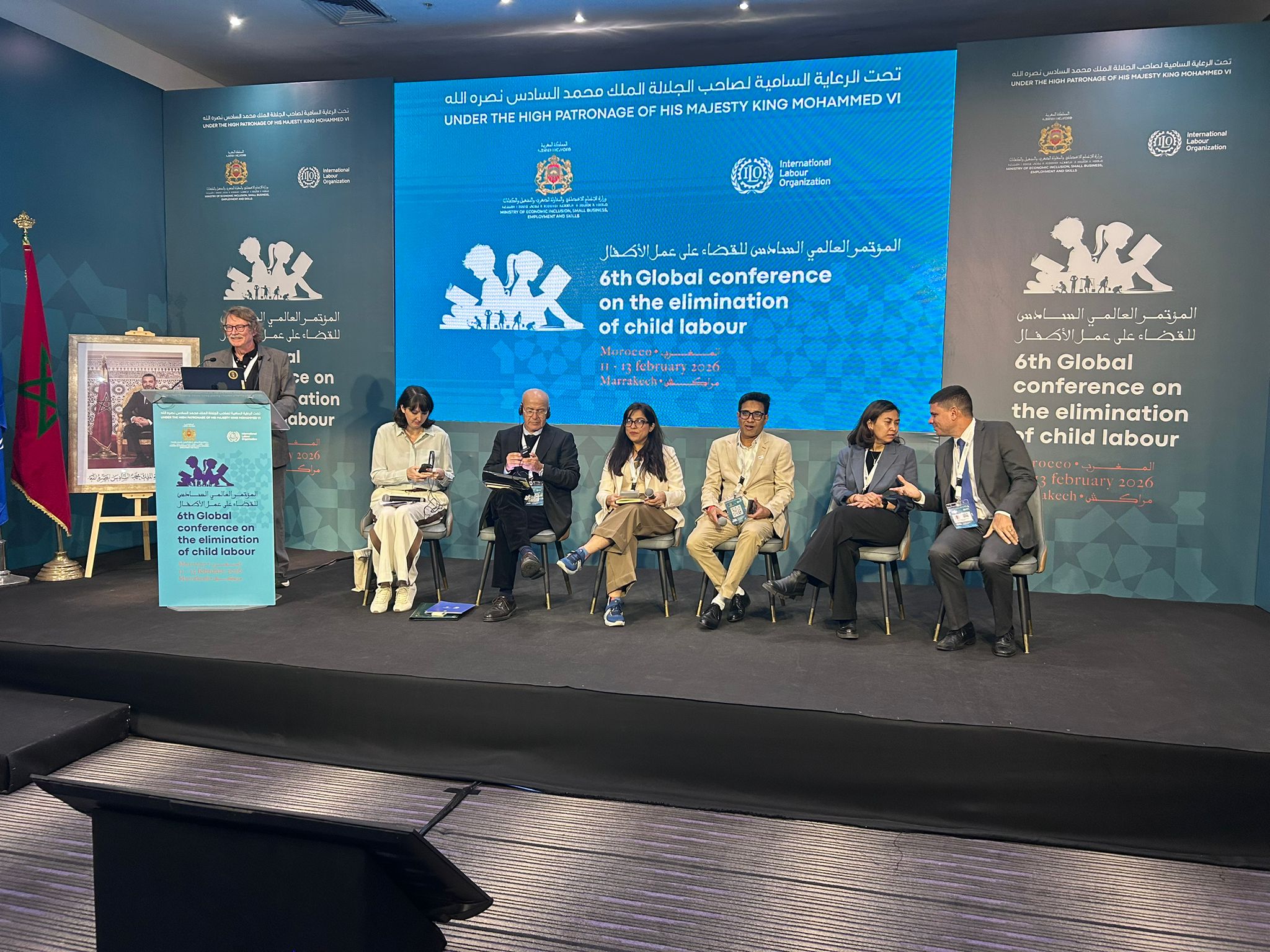
Marrakech, February 2026
The 6th Global Conference on the Elimination of Child Labour came at a critical moment.
We officially missed the SDG 8.7 target to eliminate child labour by 2025. Progress has stalled. In 2026, Marrakech was not simply another conference; it was a test of the political will and commitments.
Our movement participated not just as observers, but as a voice determined to ensure that civil society, trade unions and survivors’ voices shaped the global outcome.
The increased visibility of CSOs and stronger engagement in Marrakech reflect years of sustained advocacy from our network.
The Conference adopted the Marrakech Global Framework for Action Against Child Labour, building on the Durban Call to Action on the Elimination of Child Labour and acknowledging the urgency of renewed action.
Shifting the Narrative: From Declarations to Enforcement
In our interventions across sessions, Global March and our partners consistently emphasised:
Child labour persists not because we lack frameworks but because implementation and enforcement remain weak.
We advocated for:
- Measurable national monitoring systems with disaggregated data, annual public reporting, and clear reduction targets.
- Fully costed and financed National Action Plans, with dedicated budget lines and defined institutional responsibility.
- Poverty reduction linked directly to child labour prevention, including expanded social protection and living income strategies in high-risk sectors.
- Decent work for adults, including living wages, formalisation pathways, and respect for freedom of association.
- Stronger labour inspection systems, particularly in agriculture, informal economies, and hidden workplaces.
- Binding supply chain accountability, moving beyond voluntary commitments toward mandatory due diligence and accessible remediation.
- Transparent progress reporting, with independent oversight and consequences for non-implementation.
The Marrakech Framework reflects a stronger emphasis on coordination, monitoring, and enforcement, marking an important shift in tone following the missed SDG deadline.
CSO Forum: Exposing the Policy to Practice Gap
Through the CSO Forum, we placed the spotlight on structural gaps.
We highlighted that:
- Civil society organisations are filling critical gaps left by weak implementation, often without sustained or predictable funding. Governments remain the primary duty bearers for upholding children’s rights and enforcing labour laws.
- National Action Plans on child labour must move beyond symbolic documents.
- Business and human rights obligations must translate into due diligence and remediation.
- Child labour must be seen as a labour rights and decent work issue, not a charity intervention.
“Civil society has become the emergency service; we identify, rescue, counsel and negotiate, all on project funding. That is not sustainable.” Thus, Governments must move from outsourcing child labour response to civil society toward fully financing, enforcing and institutionalising it as a core state responsibility.
Interactive session – Bridging Income, Child Labour, and Gender Equality Gap
Income alone does not prevent child labour. Without tackling gender inequality, unpaid care work and economic shocks, children remain at risk.
During the interactive session, we demonstrated that:
- Women’s unpaid care burdens expand under economic pressure.
- Girls’ labour remains hidden and normalised.
- When families face economic shocks, children are often pushed into work to help the household survive.
We argued that isolated income interventions are insufficient.
Instead, we promoted integrated Area-Based Approaches (ABA) linking:
- Social protection
- Education
- Labour market regulation
- Gender-responsive policies
- Community mobilisation
Children & Youth: From Participation to Power
Building on Durban, the Global March Movement strongly advocated for meaningful child and youth engagement.
The Global Call to Action by Children and Youth to End Child Labour reinforced demands for:
- Free and inclusive education
- Strong enforcement of labour laws
- Social protection systems
- Safe reporting and grievance mechanisms
- Ongoing youth participation in policy monitoring
Marrakech provided expanded space for youth voices. We consider this progress, but participation must now translate into structural inclusion. We must move away from tokenistic representation and listen to the voices of survivors as a voice of reason and change.
The Red Card: A Call Beyond Words
Alongside policy engagement, we amplified the Red Card Against Child Labour campaign.
The red card was a collective message:
Missed deadlines must lead to stronger action, not new excuses.
Our Contribution to the Marrakech Global Framework for Action Against Child Labour
Global March movement has consistently advocated for a shift from political declarations to enforceable, community-rooted action.
The adoption of the Marrakech Global Framework for Action Against Child Labour did not happen in a vacuum. It reflects sustained advocacy from civil society and union’s networks, including Global March, over multiple global conferences.
Accountability for missed commitments
With SDG 8.7 not achieved, we pushed for stronger monitoring, measurable implementation and clearer government responsibility. We have been advocating for better accountability for the Durban Call to Action. This Framework places greater emphasis on follow-up and enforcement, a change we have actively been advocating for.
Recognition of integrated Area-Based Approaches (ABA).
Global March has long promoted integrated, community-centred models that link social protection, labour regulation, education and gender-responsive policy. The explicit inclusion of integrated area-based approaches in the Framework reflects recognition of this as a key tool to address root causes.
Stronger Child and Youth Participation and CSO Engagement
Through the Children & Youth sessions and by amplifying the Global Call to Action by Children and Youth to End Child Labour, we supported meaningful youth participation, including the visibility of survivor voices. Members of the Global March network were actively engaged across sessions, not only advocating for participation, but also shaping discussions.
Through the CSO Forum, we stressed that governments are legally responsible for preventing and eliminating child labour. At the same time, the strong presence and coordination of our network throughout the Conference demonstrated the essential role of organised civil society in monitoring, accountability and community-level implementation.
The increased space for CSOs and survivors at this Conference reflects progress toward more inclusive international governance structures. The presence of CSOs, Trade Unions, Children and Survivors mark a significant moment towards the success of our advocacy efforts.
Participation in Drafting
We are proud to have actively contributed to the drafting process. Our Regional Coordinator for Anglophone Africa, Andrews Tagoe, played a meaningful role in shaping discussions on accountability, integrated area-based approaches and implementation. His engagement helped ensure that grassroots realities and frontline experience were reflected in the final global commitments.
The Next Phase: Implementation
The Durban commitments remain unfinished. The Marrakech Framework sets direction. Now comes the difficult part: delivery.
As a movement, we commit to:
- Monitor national implementation of the Framework
- Advocate for financing of National Action Plans
- Promote ABA and community-based solutions
- Strengthen labour rights and decent work advocacy
- Ensure child and survivor voices remain central